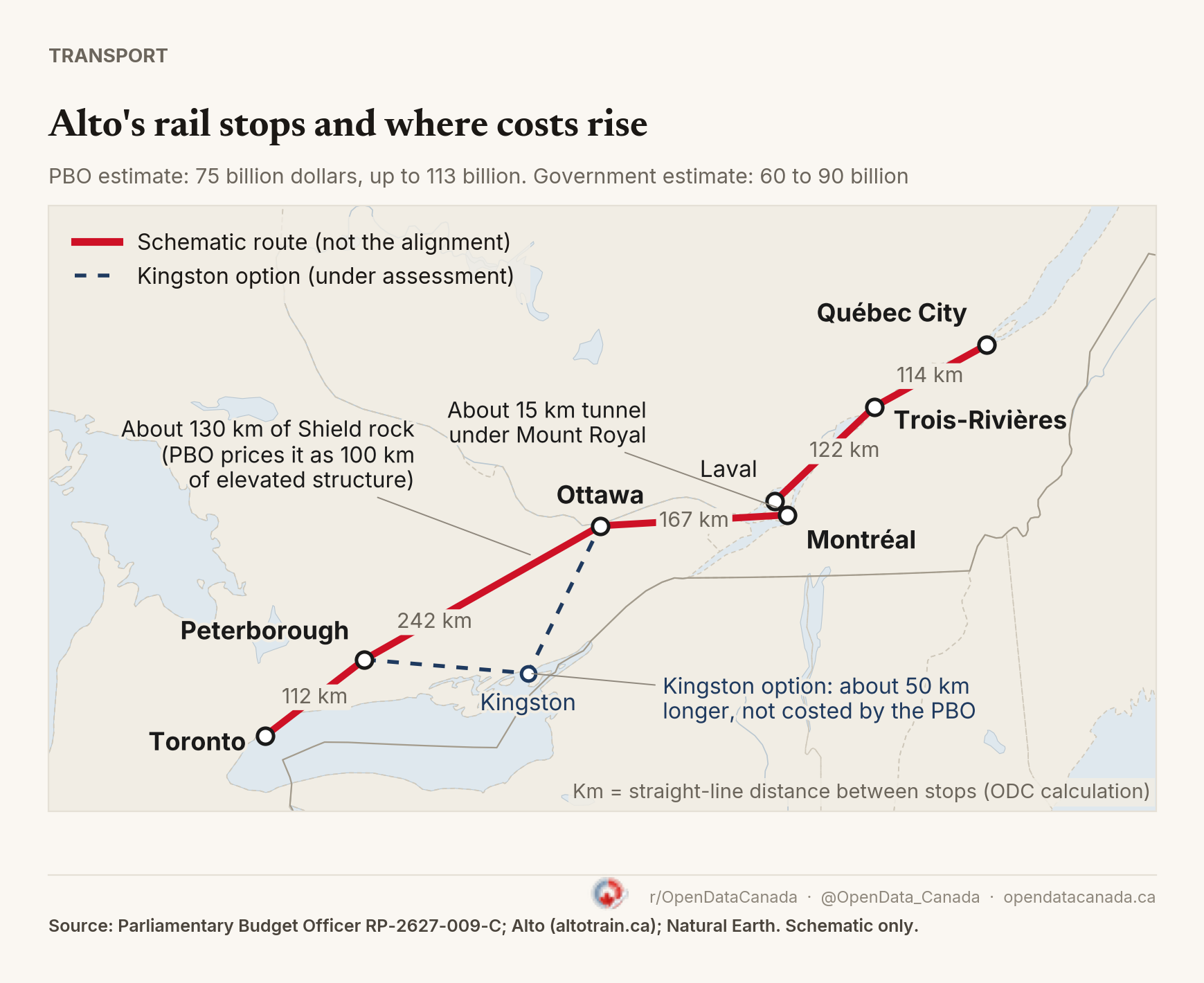
If it passes, here is what changes for landowners along the corridor:
- No public hearings. Ottawa could expropriate land without a hearing, and transfer ownership directly to a private consortium — not the Crown.
- A separate law for one project. Alto would be exempt from the entirety of the Expropriation Act, plus the Railway Relocation and Crossing Act and key sections of the Railway Safety Act and Impact Assessment Act. The High-Speed Rail Network Act would carry its own complete expropriation process instead.
- An eight-year freeze. The government could lock a property down with a right of first refusal for up to eight years, and ban the owner from building, adding on, or digging for four years — before deciding whether it even wants the land.
- A vague notice takes everything. If an expropriation notice doesn’t say which part of a property is being taken, it would automatically seize 100% of the owner’s property rights, wiping out easements, leases, and rights-of-way.
- Farmers pay for crossings. Split farms and municipalities would be forced into private arbitration over crossings, splitting costs of up to $25,000 per party plus legal fees — and arbitrators could bill landowners for part of building or maintaining a crossing. At 300 km/h, every crossing has to be an overpass or underpass.
“Both in terms of dollar value and the number of private properties required, in my view, it will be the largest expropriation project in modern Canadian history.” — Ajay Gajaria, municipal and land-use planning lawyer, to CBC News
The part that should worry any owner: the limbo
A right of first refusal sitting on title for eight years makes a property very hard to sell. As Gajaria put it, owners “may have a circumstance where you cannot market or sell your property potentially for eight years, potentially longer.” A buyer who sees the Crown’s right to match the best offer will walk away — or discount hard.
The four-year work freeze is just as costly. No building, no major addition, no digging without the transport minister’s permission — and any increase in value from work done in that period is legally excluded from the expropriation payout. The minister’s discretion to impose the ban would be widened to consider “any factor … including the public interest.”
This builds on Bill C-15, passed in March 2026, which already removed the requirement to negotiate a purchase before expropriating and replaced public hearings with written objections. The new legislation would scrap the remaining oversight. The Alto changes sit in Division 44 of the ways and means motion (clauses 590 to 604).
The other side of the ledger
To be fair, the case for the line is real. Alto says it will generate around $24.5 billion in economic benefits a year once running, and the government calls it a bold step to meet growing transportation needs. The NDP supports high-speed rail but has reservations about these powers — its leader, Avi Lewis, said expropriation is sometimes necessary, “but that’s the last resort.” The Conservatives and the Bloc Québécois oppose the project, pointing to the expropriations. Alto declined to comment on the proposed legislation.
Farmers and municipalities are already pushing back. MP Michael Barrett wrote to the Transport Minister on November 24 opposing the changes, citing a riding survey of more than 1,400 respondents — 95% opposing a route through the community — and arguing farmers should not pay for access to their own land.
What it means for owners
If you own land, a farm, or a home anywhere near the proposed corridor — Toronto to Peterborough to Ottawa to Montréal to Québec City — three things matter right now. First, the exact route still isn’t published, so nobody along the corridor knows yet whether their land is in the way. Second, a right of first refusal or work prohibition can land on your title years before any expropriation decision, and it will show up the moment you try to sell or build. Third, if a notice ever arrives, read exactly what land it describes — under the new rules, a vague notice takes all of it.
The question for owners is simple: if the state can freeze your land for years, take all of it on a vague notice, and hand the deed to a private consortium, what is property ownership worth along that corridor?
Own property near the corridor?
If you own land, a farm, or a home anywhere near the proposed Alto route and want to talk through what this could mean for your property, message me directly.
Message on WhatsApp Call 647-931-5470Sources: CBC News — “Ottawa proposes sweeping new land-seizure powers for Alto high-speed rail project,” Lisa Mayor, November 24, 2026 · The Alto Files — Division 44 analysis · Open Data Canada — Alto route map
This article is commentary on proposed legislation, not legal advice. The legislation is a notice of ways and means motion; its text can change when the bill is tabled.